It's taken me a while to write this.
If I'd written this in October - I'd have been able to talk about Completing the Marathon Majors.
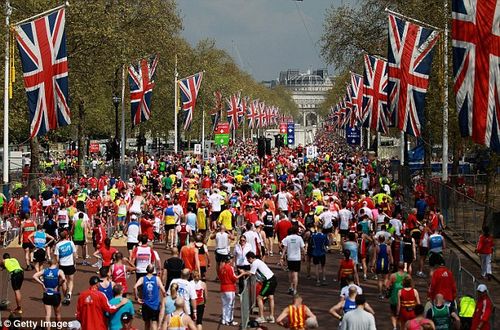
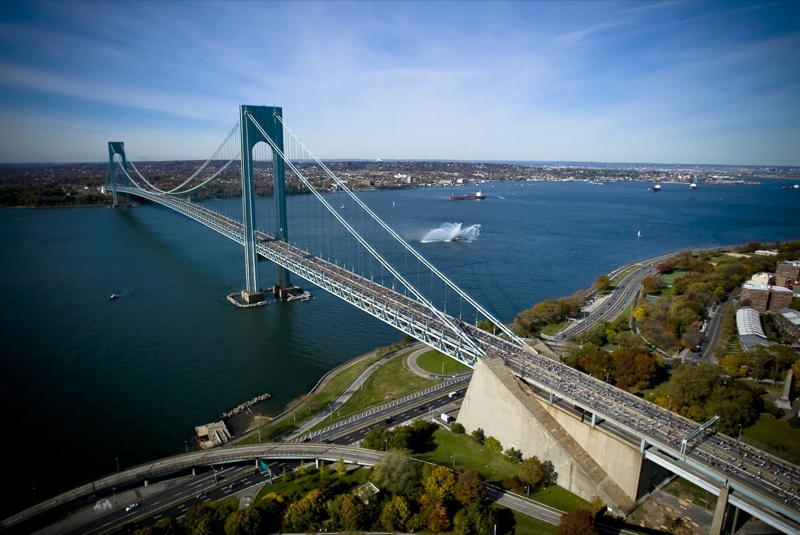
The 5 major marathons around the world. Berlin, Boston, Chicago, London and New York.
When I finished - I definitely thought I was one of the select few to have run the set. And I was.

Until last month, when they decided to add a 6th World Marathon Major. Grrr !!
So tentatively - I'll be heading to run Tokyo in February 2014.
The Build Up
My running summer had not gone particularly well.
I flew into Berlin less than 48 hours before the race was due to start. I caught the metro to my hotel in the Mitte area of the city - just to the east of where the Wall had been. Walking along partly cobbled streets, with cafes, restaurants and boutique stores, I immediately started to change my opinion of the city. There were very few cars, lots of people walking and cycling. Very laid back.

I hit the expo that afternoon - in a hangar of an old airfield in the city, and spent most of the Saturday hanging out in the Mitte in coffee shops, interspersed with shoveling carbs down my throat.
I had a very good, very spicy Indian dish the evening before the race, then went back to the hotel and watched college football via my slingbox connection to home.
The 8 hour time difference meant that, for the first time ever in a marathon and perhaps the first time ever before a race, I slept until the alarm. No matter my body clock thought it was still 10pm at night - I felt reasonably refreshed.
Like Chicago - Berlin is a big loop of the city, starting and finishing at the same park, running through what was both East and West Berlin.
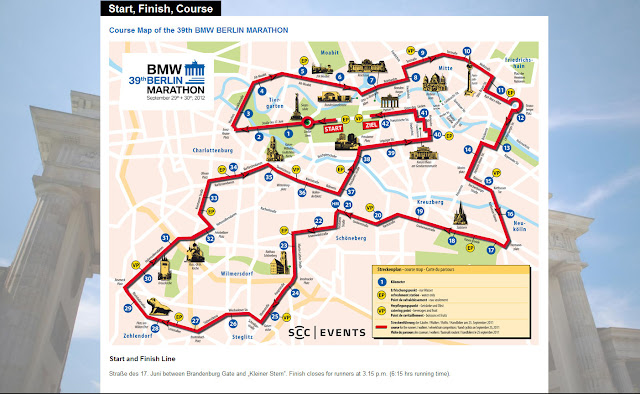
The start was just over a mile away from my hotel in a large park - the Tiergarten - so I walked.
The bag check area was well marked, but then the directions from there to the start line itself was confusing. I'm sure it was compounded by my lack of German language skills, but with less than 20 minutes to go I noticed many runners, like me, frantically trying to figure out where to go.
I finally found the right path for my corral and walked through a wooded area of the Tiergarten.
Unlike Chicago, New York and Boston where you find people desperately trying to find somewhere to use the bathroom at the last minute - here there was an obvious choice. Lots of trees.
In Berlin you are seeded by your estimated time. Signing up in 2011, I'd over optimistically put myself into the 2:50 - 2:59 grouping, which was still only the 'C' corral.
Speedy Europeans. As with all big races, we were packed in pretty tightly a few minutes before the off.
And then the dancing started.
Literally.
On came some aerobic dance music, and 90% of the runners started jumping and dancing together as part of a warmup routine. It felt like stumbling into a macarena convention.
Crazy Europeans.
My 10th marathon, and the 10th time I'd used the trash bag porto potty trick. Unfortunately this time - I hadn't been able to find a gatorade type bottle with a wider lid. Perhaps because of the more stringent re-cyling movement, but the bottles in the shops all seemed to be the regular smaller sized water bottle openings.
There was a lot more 'aiming' and a lot more 'missing' than normal inside the trash sack that morning.
The Race
Nice. On pace. We turned north and crossed the river. Then started heading east. Maybe a little faster.
6:41
Suddenly I could feel something on my shoe. I looked down and my laces on one shoe were undone. Rookie !! That's never happened before. The timing chip they provide is one that needs to be threaded through the laces. Clearly I hadn't double knotted the thing. I debated running 23 miles with it undone and quickly thought better of it. I pulled to the side and stopped and tied it up.
15 seconds lost.
6:52
I was starting to recognize the area we were running through. It was where I'd run the morning before as a shake out run. To the right was the Reichstag, and then we were heading into the Mitte.

I'd read Hitler's biography 10 years before and remembered some of the history of the area with Reichstag being burned.

And before you start making assumptions of me on the far right fringes with a shaven head - I read Churchill's and Stalin's too that summer....
6:35
A bit over eager there trying to make up for the shoelace stop. The crowds were impressive. Pretty much the whole way. Berlin was definitely up there for support. I'd probably rate it equal with New York and London for whole course support, with Boston and Chicago a little behind.
6:52
A big contrast between Berlin and London is the water stops. In London - they're every mile, where you can take a bottle of water or sports drink.
In Berlin they were a lot less frequent, and the cups were made of a very brittle plastic. You couldn't crush them into a V shape to drink without the thing cracking or you spilling it all down your front. As a result, I once again was probably taking in less fluid than my body wanted.
6:40
This was feeling pretty good though. My garmin was telling me I was now slightly ahead of pace.
Take it easy. It was warming up. The temperatures were only in the 50s, but it was bright sun without a lot of shade. Not as cool as I'd hoped.
6:45, 6:43, 6:41,
I was trying a new approach to my gels. Previously I've had a hard time keeping more than a few down. 3 is the most I've managed in a race. One of the theories from the testing I had done at the Boulder Center of Sports Medecine was that carbs could be an issue. I'd changed to a Powerbar gel with a dual carb mix (maltodextrin and fructose) to aid faster absorption. This time I was going to try and swallow 6 of the things.
At the 3, 7, 11, 15, 19, and 23 mile points.
Or whatever the hell that was in kilometers.
6:41
My 3rd gel. I wasn't getting that queasy feeling in my stomach that I've had in the past, so maybe this was going to be okay.
6:50, 6:48
The garmin had me averaging around 6:46. I'm not naive enough to trust it completely. Rarely is it completely accurate with it's infamous 'garmin drift'. But add 5 seconds / mile - and I seemed to be on target.
As we approached the half - I had my first, and really only chance to get an accurate measure of my pace.
We crossed the 21.097 KM point. I checked my watch and saw 1:29:48 for the half.
Ok - that's about perfect.
My coach had given me an analogy of riding the bus. For the first 3/4 of the race - you try to take things as easy as possible. Sit on the bus, don't do anything you don't need to do, conserve your energy. Then the last 1/4 - you need to get off the bus and work.
Unfortunately for me. I was at the half way point and was already off the bloody bus pushing.
This wasn't feeling as easy as it should at the half.
But I wasn't going to slow down.
6:42
I'd read a quote in an article by Greg McMillan on the plane that resonated.
"You ain't gonna get out of the race pain-free so you gotta pick the pain — the pain of the race or the pain of regret."
I'd had that pain of regret before. I felt I'd been too quick to give myself permission to slow down when things inevitably started to hurt.
This time I was prepared for that. I was determined not to give in.
One mile at a time. Grind. Grind. Embrace the pain.
6:50
Gel. Spill water down my front.
6:49
6:51
Still definitely grinding.
While my garmin showed me still on track overall, I was a little skeptical. By this point in the race - people are normally starting to slow down. I should be overtaking more people if I'm maintaining pace. Instead - I notice a few people overtaking me.
7:05
Uhoh. That was partly due to a crowded water stop, but I could tell I was slowing.
6:51
A slight second wind. I think that's the first time that's happened to me.
Gel. Spill water down my front.
6:55
7:00
7:03
22 miles in. My garmin was showing 6:50 overall pace. I wasn't thinking too clearly. I thought I might still be on pace for sub 3, but in my heart I felt by the fact that more people seemed to be passing that I was now behind.
But I wasn't giving up. I figured I could get to 5K to go, and push to make up the 30 or so seconds.
7:06
Grind
7:03
Grind
Crike ! I'm 24 miles in, the wheels haven't fallen off. It really does seem to be partly mind over matter.
I think the sub 3 has probably slipped by, but I'm not falling apart. I'm going to run a 3:01. That's a 3 minute PR.
Boom. Suddenly my right leg locked up with agonizing cramps in my hamstring. No warning - just boom. I stopped dead in my tracks and almost hit the road, yelping. I tried to stretch, and after 20 or so seconds the pain subsided. I gingerly started up again. After a few seconds it seemed okay and I tried to get back on pace, but it was in the back of my mind - would it go again ?
7:36
At this point I was liking the idea of kilometers more. I knew the marathon was a little over 42K. I'd been counting them down ever since I hit 30K. They were counting past a lot quicker than the miles were.
Maybe there's something to be said for this metric system after all.
Under 2K to go. Think - you're going to be running through the Brandenburg Gate pretty soon - one of the highlights of the race, just before the finish line.
After several turns on side streets - I could see it in the distance.
I noticed people pointing at me and wondered why. Later I realized I had a bleeding nipple. Another first ! The bleeding nipple didn't hurt as badly as my legs though.
200 yards before the gate. Boom. It happened again. This time the left hamstring locked up with cramps. Are you frigging serious ? I've never had cramps in a race before, and here I was getting 2 in the last few miles on different legs ?
This one was tougher. It really took some time to get going. Each step for a while felt like it was going to lock up again.
8:00
Hmmm. That's 26 miles on the garmin. That means I've got 0.2 to go in theory. But the finish line still looks a bloody long way away. I still need to get through the Brandenburg Gate, and then there seems to be another long straight until the line.
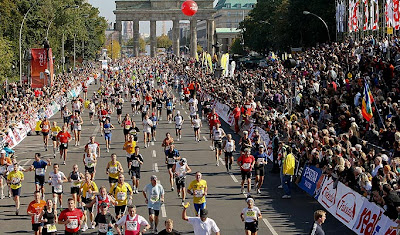
Through the Gate. So much for finishing there - it's another 500 yards or so (as this photo shows).
See the clock counting down in the distance. With the cramps, the thoughts of a 3:01 or 3:02 had become - beat your 3:04 PR.
Bloody garmin. Bloody cramps. I try to pick up the pace. I've got a visible limp with my left leg, but the finish line is coming up fast.
Last 0.6 miles. 0.6 miles ?!! 7:18
And I'm over the line. I missed my PR by19 seconds. 3:04:27.
I stumble back to the gear check and then stagger back to the hotel. Later that afternoon I met up with running friends in a bar to celebrate their achievements, and drink copious amounts of Long Island Ice Tea celebrating the completion of the marathon majors. Partei wie ein Rockstar !

Reflecting later.
Even if I'd had perfect garmin accuracy, I don't think I was on track for the sub 3. Without the cramps and shoe lace stop, I'd have run around 3:02.
That's still significant for me. That would have been a 2 minute PR on the back of a sub-par training cycle with limited enthusiasm.
To me that tells me the mental side is just as important as the physical. Intuitively I knew that, but had never been able to put it into practice. This time I felt I was much stronger mentally. I didn't allow myself to slow down to make it easier. I kept pushing, even when it hurt. And I realized that I could push through. It wasn't pleasant, but it was over at the line.
Although I did get another mental lesson. Don't make any assumptions - even if you're just 2 miles out and things appear to be going well. That's when I started to think about the PR I was running. Unexpected things can happen out of the blue. You need to be aware and stay focused all the way to the line.
The gel strategy seemed to help too. I didn't take the 6th for some reason. I wasn't feeling queasy. Still, that was 2 more than I've ever kept down before. Next time I'm taking all 6. Something to be said for the dual carb mix perhaps.
The cramps. That one is harder to figure. I was taking salt caps with the gels. The weather wasn't hot, but with the sun it was probably a little warmer than ideal. This one might have been a lack of water with the less frequent water stops, and the hard-to-drink-from plastic cups.
I flew to Australia the next day, took a week off running, and then slowly started up again. The race didn't seem to have taken too much of a toll, so I signed up for the California International Marathon in December. Try and make use of my new found form and mental resolve and take another crack at that sub-3 goal without having to go through another full training cycle.
And next time I'll wear nipple protectors too.

If I'd written this in October - I'd have been able to talk about Completing the Marathon Majors.
The 5 major marathons around the world. Berlin, Boston, Chicago, London and New York.
When I finished - I definitely thought I was one of the select few to have run the set. And I was.

Until last month, when they decided to add a 6th World Marathon Major. Grrr !!
So tentatively - I'll be heading to run Tokyo in February 2014.
The Build Up
My running summer had not gone particularly well.
There were no injury issues, but for the first time since 'restarting' running late in 2008, I wasn't getting faster. In fact I was getting slower.
It was a hot summer. We had 73 days over 90 degrees in Denver, with 7 over 100 degrees.
And I was traveling internationally with work. 24 hours at a time in an airplane, with the accompanying jet leg definitely wasn't helping. My training paces were slow. If I ran faster, my heart rate went through the roof.
I ran 2 half marathons over the summer. Both were 5 minutes slower than the previous year.
Not exactly inspring confidence.
I wondered if I might have an iron deficiency. How could I be sucking so badly ?
Then as Berlin started approaching, a new work trip to Australia materialized.
There was a chance I'd have to chose which I wanted to do, but fortunately timing worked so I could do them both as one big trip. The plan was to go from Denver to Berlin, run the race, then immediately fly to Singapore and then onto Perth. Work 11 days, then fly to San Francisco, via Sydney for another week, before returning to Denver. 26,500 mile round the world trip. DOMS the day after the marathon, in cattle class on a 18 hour flight to Australia. Sounds like fun....
There was a chance I'd have to chose which I wanted to do, but fortunately timing worked so I could do them both as one big trip. The plan was to go from Denver to Berlin, run the race, then immediately fly to Singapore and then onto Perth. Work 11 days, then fly to San Francisco, via Sydney for another week, before returning to Denver. 26,500 mile round the world trip. DOMS the day after the marathon, in cattle class on a 18 hour flight to Australia. Sounds like fun....
Berlin was the last of the 5 majors for me to complete (or so I believed at the time).
It was also the least enticing to me.
I'd lived in Chicago for years, so that had special memories.
Boston was the 'everyday runner's Olympics. You have to qualify and achieve that special 'BQ'.
New York I'd heard so much about. It was the biggest, with supposedly the best crowds.
London is London. The one that I'd promised myself I'd run as a 12 year old watching the first running.
But Berlin ? The only reason I was doing it was to complete the set. Perhaps because of the stories of the war from my grandparents growing up, but Germany was never a place I'd felt the urge to visit. I envisioned a very industrialized landscape, with very serious people. Not very interesting.
So in short.
Not exactly ideal preparation.
Berlin
It was also the least enticing to me.
I'd lived in Chicago for years, so that had special memories.
Boston was the 'everyday runner's Olympics. You have to qualify and achieve that special 'BQ'.
New York I'd heard so much about. It was the biggest, with supposedly the best crowds.
London is London. The one that I'd promised myself I'd run as a 12 year old watching the first running.
But Berlin ? The only reason I was doing it was to complete the set. Perhaps because of the stories of the war from my grandparents growing up, but Germany was never a place I'd felt the urge to visit. I envisioned a very industrialized landscape, with very serious people. Not very interesting.
So in short.
- I wasn't particularly 'excited' about the event.
- My form sucked.
- I had a 3.5 week work trip to think about and pack for.
Not exactly ideal preparation.
Berlin
I flew into Berlin less than 48 hours before the race was due to start. I caught the metro to my hotel in the Mitte area of the city - just to the east of where the Wall had been. Walking along partly cobbled streets, with cafes, restaurants and boutique stores, I immediately started to change my opinion of the city. There were very few cars, lots of people walking and cycling. Very laid back.

I hit the expo that afternoon - in a hangar of an old airfield in the city, and spent most of the Saturday hanging out in the Mitte in coffee shops, interspersed with shoveling carbs down my throat.
I had a very good, very spicy Indian dish the evening before the race, then went back to the hotel and watched college football via my slingbox connection to home.
The 8 hour time difference meant that, for the first time ever in a marathon and perhaps the first time ever before a race, I slept until the alarm. No matter my body clock thought it was still 10pm at night - I felt reasonably refreshed.
Like Chicago - Berlin is a big loop of the city, starting and finishing at the same park, running through what was both East and West Berlin.
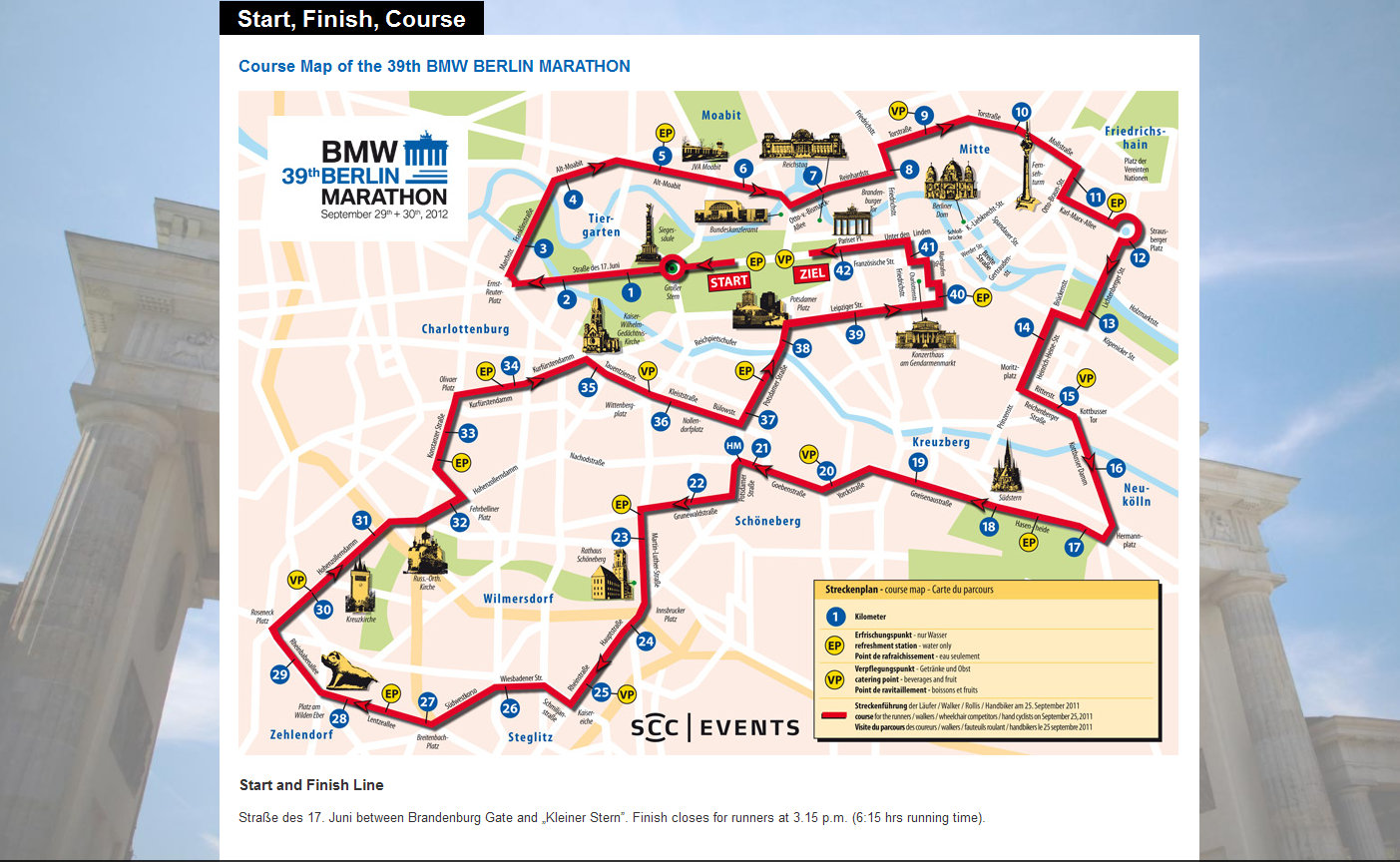
The start was just over a mile away from my hotel in a large park - the Tiergarten - so I walked.
The bag check area was well marked, but then the directions from there to the start line itself was confusing. I'm sure it was compounded by my lack of German language skills, but with less than 20 minutes to go I noticed many runners, like me, frantically trying to figure out where to go.
I finally found the right path for my corral and walked through a wooded area of the Tiergarten.
Unlike Chicago, New York and Boston where you find people desperately trying to find somewhere to use the bathroom at the last minute - here there was an obvious choice. Lots of trees.
In Berlin you are seeded by your estimated time. Signing up in 2011, I'd over optimistically put myself into the 2:50 - 2:59 grouping, which was still only the 'C' corral.
Speedy Europeans. As with all big races, we were packed in pretty tightly a few minutes before the off.
And then the dancing started.
Literally.
On came some aerobic dance music, and 90% of the runners started jumping and dancing together as part of a warmup routine. It felt like stumbling into a macarena convention.
Crazy Europeans.
My 10th marathon, and the 10th time I'd used the trash bag porto potty trick. Unfortunately this time - I hadn't been able to find a gatorade type bottle with a wider lid. Perhaps because of the more stringent re-cyling movement, but the bottles in the shops all seemed to be the regular smaller sized water bottle openings.
There was a lot more 'aiming' and a lot more 'missing' than normal inside the trash sack that morning.
The Race
9am on the dot. As you'd expect in Germany. We were off.

The first 2 miles were straight along a wide road, with a large roundabout with a statue after half a mile, with runners streaming round on both sides.
Except it wasn't half a mile in. It was 0.8 kilometers.
In the other 4 major races, markers had been placed at both the mile and km marks. I'd naively expected the same. Nein ! There wasn't a single mile marker on the course.
The 26 pace split markings on my forearm to check each mile were useless.
I was totally dependent on my garmin. Which turned out to be an issue.
While I didn't believe I was in sub 3 shape - I didn't want to run an easy race. I decided to start off a little slower, pick things up, hit the half in just under 1:30, and then see how long I could hang on.
The first half mile was crowded. Clearly a lot of others had over-estimated their goal time even more than me. I had to duck and dive. While I wanted to start slower than goal pace (6:51 / mile) - I didn't want to be in too big a hole immediately.
Things slowly opened up and I hit the imaginary 1.608 kilometer mark... the paces I'm posting are all taken from my garmin.
7:09
The course was heading west - away from the Brandenburg gate. The crowds were noisy. It was fairly cool early on (high 40s I'd guess), but blue sky and the sun rising.
6:50
Nice. On pace. We turned north and crossed the river. Then started heading east. Maybe a little faster.
6:41
Suddenly I could feel something on my shoe. I looked down and my laces on one shoe were undone. Rookie !! That's never happened before. The timing chip they provide is one that needs to be threaded through the laces. Clearly I hadn't double knotted the thing. I debated running 23 miles with it undone and quickly thought better of it. I pulled to the side and stopped and tied it up.
15 seconds lost.
6:52
I was starting to recognize the area we were running through. It was where I'd run the morning before as a shake out run. To the right was the Reichstag, and then we were heading into the Mitte.

I'd read Hitler's biography 10 years before and remembered some of the history of the area with Reichstag being burned.

And before you start making assumptions of me on the far right fringes with a shaven head - I read Churchill's and Stalin's too that summer....
6:35
A bit over eager there trying to make up for the shoelace stop. The crowds were impressive. Pretty much the whole way. Berlin was definitely up there for support. I'd probably rate it equal with New York and London for whole course support, with Boston and Chicago a little behind.
6:52
A big contrast between Berlin and London is the water stops. In London - they're every mile, where you can take a bottle of water or sports drink.
In Berlin they were a lot less frequent, and the cups were made of a very brittle plastic. You couldn't crush them into a V shape to drink without the thing cracking or you spilling it all down your front. As a result, I once again was probably taking in less fluid than my body wanted.
6:40
This was feeling pretty good though. My garmin was telling me I was now slightly ahead of pace.
Take it easy. It was warming up. The temperatures were only in the 50s, but it was bright sun without a lot of shade. Not as cool as I'd hoped.
6:45, 6:43, 6:41,
I was trying a new approach to my gels. Previously I've had a hard time keeping more than a few down. 3 is the most I've managed in a race. One of the theories from the testing I had done at the Boulder Center of Sports Medecine was that carbs could be an issue. I'd changed to a Powerbar gel with a dual carb mix (maltodextrin and fructose) to aid faster absorption. This time I was going to try and swallow 6 of the things.
At the 3, 7, 11, 15, 19, and 23 mile points.
Or whatever the hell that was in kilometers.
6:41
My 3rd gel. I wasn't getting that queasy feeling in my stomach that I've had in the past, so maybe this was going to be okay.
6:50, 6:48
The garmin had me averaging around 6:46. I'm not naive enough to trust it completely. Rarely is it completely accurate with it's infamous 'garmin drift'. But add 5 seconds / mile - and I seemed to be on target.
As we approached the half - I had my first, and really only chance to get an accurate measure of my pace.
We crossed the 21.097 KM point. I checked my watch and saw 1:29:48 for the half.
Ok - that's about perfect.
My coach had given me an analogy of riding the bus. For the first 3/4 of the race - you try to take things as easy as possible. Sit on the bus, don't do anything you don't need to do, conserve your energy. Then the last 1/4 - you need to get off the bus and work.
Unfortunately for me. I was at the half way point and was already off the bloody bus pushing.
This wasn't feeling as easy as it should at the half.
But I wasn't going to slow down.
6:42
I'd read a quote in an article by Greg McMillan on the plane that resonated.
"You ain't gonna get out of the race pain-free so you gotta pick the pain — the pain of the race or the pain of regret."
I'd had that pain of regret before. I felt I'd been too quick to give myself permission to slow down when things inevitably started to hurt.
This time I was prepared for that. I was determined not to give in.
One mile at a time. Grind. Grind. Embrace the pain.
6:50
Gel. Spill water down my front.
6:49
6:51
Still definitely grinding.
While my garmin showed me still on track overall, I was a little skeptical. By this point in the race - people are normally starting to slow down. I should be overtaking more people if I'm maintaining pace. Instead - I notice a few people overtaking me.
7:05
Uhoh. That was partly due to a crowded water stop, but I could tell I was slowing.
6:51
A slight second wind. I think that's the first time that's happened to me.
Gel. Spill water down my front.
6:55
7:00
7:03
22 miles in. My garmin was showing 6:50 overall pace. I wasn't thinking too clearly. I thought I might still be on pace for sub 3, but in my heart I felt by the fact that more people seemed to be passing that I was now behind.
But I wasn't giving up. I figured I could get to 5K to go, and push to make up the 30 or so seconds.
7:06
Grind
7:03
Grind
Crike ! I'm 24 miles in, the wheels haven't fallen off. It really does seem to be partly mind over matter.
I think the sub 3 has probably slipped by, but I'm not falling apart. I'm going to run a 3:01. That's a 3 minute PR.
Boom. Suddenly my right leg locked up with agonizing cramps in my hamstring. No warning - just boom. I stopped dead in my tracks and almost hit the road, yelping. I tried to stretch, and after 20 or so seconds the pain subsided. I gingerly started up again. After a few seconds it seemed okay and I tried to get back on pace, but it was in the back of my mind - would it go again ?
7:36
At this point I was liking the idea of kilometers more. I knew the marathon was a little over 42K. I'd been counting them down ever since I hit 30K. They were counting past a lot quicker than the miles were.
Maybe there's something to be said for this metric system after all.
Under 2K to go. Think - you're going to be running through the Brandenburg Gate pretty soon - one of the highlights of the race, just before the finish line.
After several turns on side streets - I could see it in the distance.
I noticed people pointing at me and wondered why. Later I realized I had a bleeding nipple. Another first ! The bleeding nipple didn't hurt as badly as my legs though.
This one was tougher. It really took some time to get going. Each step for a while felt like it was going to lock up again.
8:00
Hmmm. That's 26 miles on the garmin. That means I've got 0.2 to go in theory. But the finish line still looks a bloody long way away. I still need to get through the Brandenburg Gate, and then there seems to be another long straight until the line.

See the clock counting down in the distance. With the cramps, the thoughts of a 3:01 or 3:02 had become - beat your 3:04 PR.
Bloody garmin. Bloody cramps. I try to pick up the pace. I've got a visible limp with my left leg, but the finish line is coming up fast.
Last 0.6 miles. 0.6 miles ?!! 7:18
And I'm over the line. I missed my PR by19 seconds. 3:04:27.
I stumble back to the gear check and then stagger back to the hotel. Later that afternoon I met up with running friends in a bar to celebrate their achievements, and drink copious amounts of Long Island Ice Tea celebrating the completion of the marathon majors. Partei wie ein Rockstar !

Reflecting later.
Even if I'd had perfect garmin accuracy, I don't think I was on track for the sub 3. Without the cramps and shoe lace stop, I'd have run around 3:02.
That's still significant for me. That would have been a 2 minute PR on the back of a sub-par training cycle with limited enthusiasm.
To me that tells me the mental side is just as important as the physical. Intuitively I knew that, but had never been able to put it into practice. This time I felt I was much stronger mentally. I didn't allow myself to slow down to make it easier. I kept pushing, even when it hurt. And I realized that I could push through. It wasn't pleasant, but it was over at the line.
Although I did get another mental lesson. Don't make any assumptions - even if you're just 2 miles out and things appear to be going well. That's when I started to think about the PR I was running. Unexpected things can happen out of the blue. You need to be aware and stay focused all the way to the line.
The gel strategy seemed to help too. I didn't take the 6th for some reason. I wasn't feeling queasy. Still, that was 2 more than I've ever kept down before. Next time I'm taking all 6. Something to be said for the dual carb mix perhaps.
The cramps. That one is harder to figure. I was taking salt caps with the gels. The weather wasn't hot, but with the sun it was probably a little warmer than ideal. This one might have been a lack of water with the less frequent water stops, and the hard-to-drink-from plastic cups.
I flew to Australia the next day, took a week off running, and then slowly started up again. The race didn't seem to have taken too much of a toll, so I signed up for the California International Marathon in December. Try and make use of my new found form and mental resolve and take another crack at that sub-3 goal without having to go through another full training cycle.
And next time I'll wear nipple protectors too.